
From Gridlock to Growth: Why Vermont Needs ROOT Zones
Miro Weinberger
January 30, 2026
Vermont has taken important steps to address our housing shortage. We've mapped out where new homes should go and committed $2 billion to help towns build the roads, water systems, and other infrastructure needed to support new housing.
But for these changes to deliver results, we must address one more major barrier: our dysfunctional permit appeals system. No matter how great the need or community support for a project, under our current system obstructionist appeals routinely hold up projects for years or kill them entirely.
The Problem: A Broken Permit System
Last year in the city of Montpelier, all four permitted housing projects were challenged with appeals. Three are still tied up. This happens across Vermont—projects that communities need get stuck in legal limbo.
And that's just what we can see. Many developers scale back their projects or never propose them at all, knowing that even with permits, appeals can drag on for years. The homes we've lost this way are impossible to count, but I suspect the real number is enormous.
I've seen this problem from both sides. As a developer in the 2000s, I had a Burlington project delayed five years by appeals that went to the Vermont Supreme Court. Twenty-five households live in that building today, but once we understood how the appeals system works, we never pursued another project like it.
As Burlington's mayor, I saw the broader damage. Virtually every permitted project faced appeal threats. Neighbors used the leverage to extract concessions from developers, driving up costs. My administration spent countless hours mediating between builders and neighbors just to get anything built.
Why Burlington's Approach Works
Burlington took a major step towards fixing this problem in 2017 by changing how it reviews housing projects downtown. Instead of asking vague questions like "does this fit the character of the neighborhood?" the city established clear, objective dimensional standards that made approval predictable. For example: buildings can no longer be set back with parking lots in front, small lots are explicitly allowed, and mixed-uses can combine without buffers between them. These standards focus on the form—how buildings relate to the street and each other—rather than obsessing over what happens inside the building.
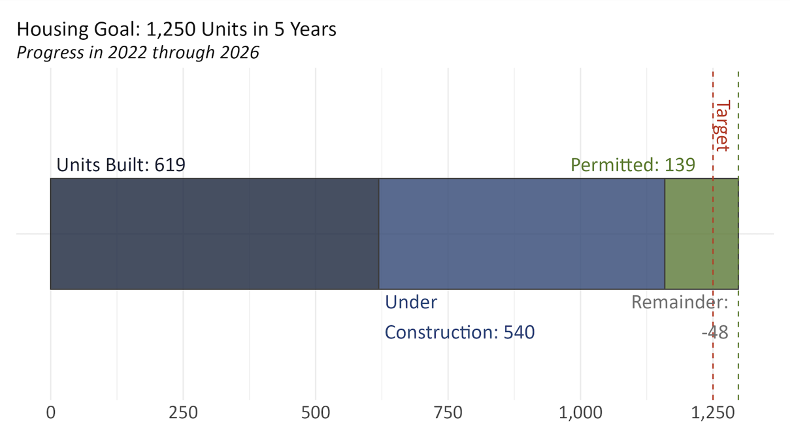
The reform worked: projects that follow the rules now get their permits. Hundreds of new homes have been permitted and built or are in construction, putting the city on track to meet the goal we announced to quadruple our housing rate. Most striking: there hasn't been a single development permit appeal in the new code area since 2017.
Bringing This Solution Statewide: ROOT Zones
LBH spent the summer and fall developing a new concept that aimed at comprehensively reducing appeals in the new housing growth areas created by Act 181: ROOT Zones.
The ROOT Zone concept is based on the premise that we can fix our statewide appeals system problem by creating a direct, inexpensive, and fast path for municipalities around the state—especially our smallest, rural towns—to shift from a system of traditional subjective zoning to local rules grounded in clear and objective standards.
How ROOT Zones work: In our vision, the state will create a model code with clear and objective standards for all the issues that towns need to consider in their subdivision and site plan reviews. This will be a form-based code, but it will be a “lite” version that regulates what is important and is cost-sensitive so that it does not unnecessarily add cost to new home construction. Towns adapt the code to their community and adopt it after engaging their voters. Projects that meet the standards get approved—no hearings, no subjective decisions, no appeals.
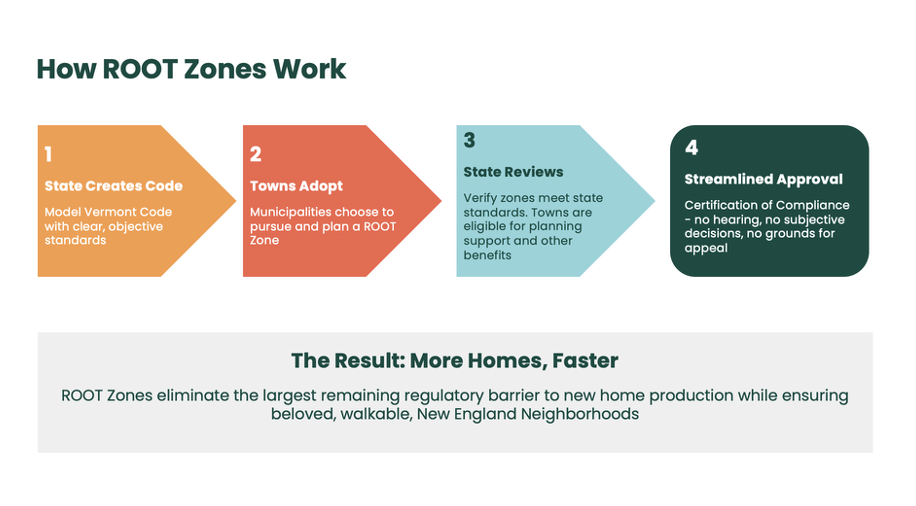
This means more homes built faster because communities are making decisions about how they want to grow democratically, up front, rather than fighting over every project. The standards ensure new development results in new, beloved neighborhoods grounded in Vermont's time-honored compact, walkable form. And critically, ROOT gives smaller towns without planning staff a template and support to produce housing.
ROOT isn't the only solution on the table. The Governor's Homes for All program is tackling appeals by creating pre-approved housing designs that communities can fast-track. A recent Land Use Review Board report proposes ways to shorten appeal timelines. And other groups are exploring limits on what can be appealed in the first place.
We support action on all these fronts. ROOT would be a comprehensive fix, giving communities a clear path to by-right housing approvals, but any progress on appeals will help unlock housing production across Vermont.
Moving Forward
We are excited to report that this proposal is getting serious attention in Montpelier. Yesterday the Senate Natural Resources Committee took preliminary action on a bill to create ROOT Zones.
Want to learn more? Read the full concept paper here.